Million Lords: World Conquest
- 4.2
- Rating
- 1.00M
- Installs
- Free
- Price
 Analysis by App-foxy
I went into Million Lords: World Conquest expecting a familiar mobile strategy game, but its appeal became clearer after a few sessions: it wants me to make a quick territorial decision, see the map react, collect the result, and then decide whether I have enough time and resources to push again. That rhythm is more important than any single battle. The game is built around protecting a kingdom, forming alliances, attacking castles, and expanding an empire, yet it presents those ideas in a way that feels more immediate than a traditional city-building game.
It is a free strategy game from MILLION VICTORIES, rated 4.2 on average from around 85 thousand ratings and supported by more than a million installs. Those figures suggest a healthy audience, but they do not tell me whether it suits a particular player. In my experience, the real question is whether you enjoy making imperfect decisions under pressure. If you want a slow, decorative kingdom simulator, this may feel too focused on territory and momentum. If you like watching a map change because of your choices, it has a much stronger chance of holding your attention.
One move starts the whole chain
I like how this section treats the opening move as a planning choice rather than a reflex: a small pause can reveal whether a capture improves your position or simply makes your border harder to manage. I also find it useful to name one short-term goal before acting, so each new patch of territory has a purpose. That sets up the next section’s focus on what makes progress feel rewarding—and when that pull can become a trap.
You May Also Like

 Blood Strike: 2.5 Anniversary
Blood Strike’s Loadouts Turn Every Drop Into a Tactical Gamble
A close look at Blood Strike’s custom loadouts: how fast access to signature weapons reshapes its battle royale rhythm, rewards preparation, and narrows the gap between fights.

 Pandora - Music & Podcasts
Pandora’s Music Is Easy to Start, but Harder to Recover
Pandora’s strength is its low-effort path from a seed to a station. Its weak spot is how much confidence it asks you to place in connection, setup, and quiet recovery.

 8 Ball Pool
 Is Built on Rivalries, Rematches, and Routine
A close look at the rivalries, rematches, shared routines, and unanswered safety questions that turn a quick pool match into a persistent mobile community.

 Samsung Music
’s Quiet Strength Is Playing What You Already Own
Its reach comes less from spectacle than from dependable access to a personal library. That simplicity is both the app’s strongest retention engine and its ceiling.

 AccuWeather: Weather Radar
AccuWeather Review: A Quick, Clear Forecast for Everyday Decisions
For everyday plans, the best forecast is the one you can understand quickly. AccuWeather makes rain timing, radar, and local conditions easy to act on, with a few trade-offs.

 Hill Climb Racing
Why Hill Climb Racing Still Turns Crashes Into One More Run
A tiny car, a bumpy hill and one more upgrade: Hill Climb Racing keeps resurfacing because its simple chaos makes every near-miss feel personal.
More From Our News Desk
View All News


The first action is about choosing a direction
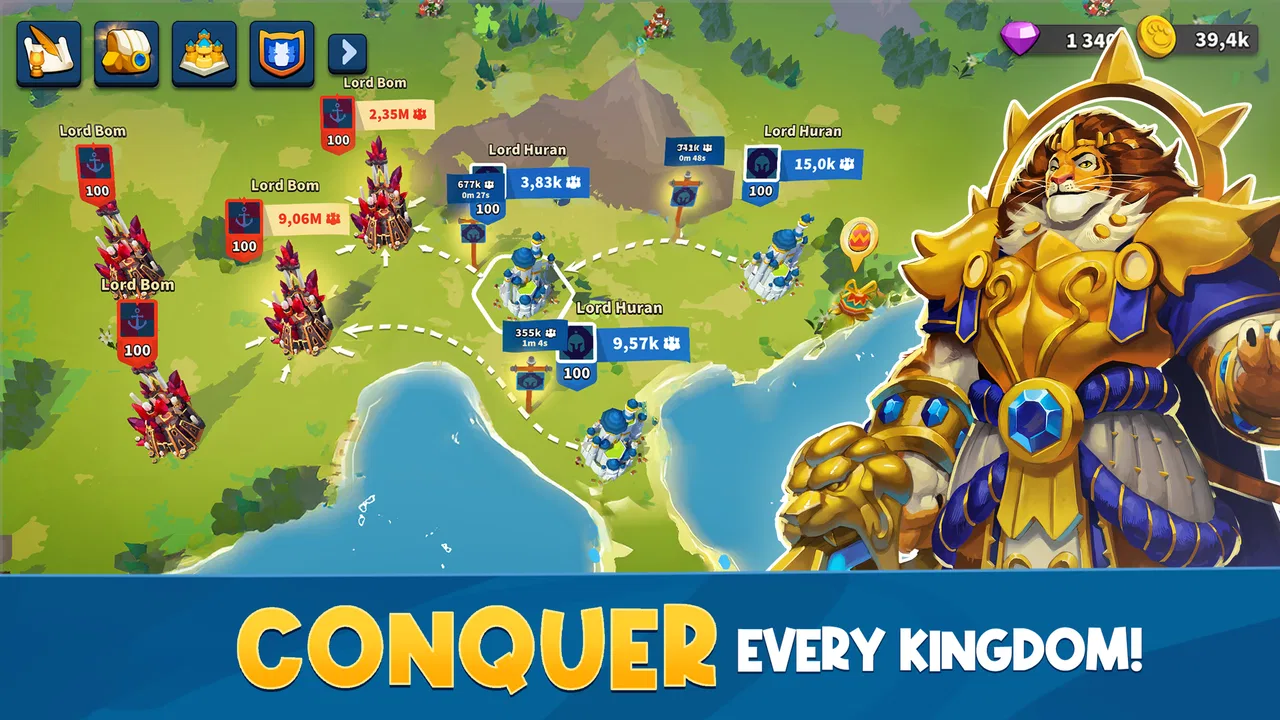
The most satisfying opening move is not simply attacking the nearest target. I first look at the shape of my territory and ask what the next capture will give me: a safer border, a route toward useful land, or a position that leaves me exposed. That small pause matters because every expansion changes the decisions around it. A successful attack is not just a victory screen; it redraws the problem I need to solve next.
This is where the game feels different from many familiar mobile strategy alternatives. In a conventional base-builder, I might spend time upgrading buildings, waiting for timers, and returning later to collect resources. Here, the map itself is the main conversation. My action is visible, immediate, and connected to the next choice. The reward is not only a number going up. It is the opening of another route, the removal of a threat, or the chance to pressure a neighboring position.
I also found that early aggression needs restraint. Capturing land because it is available can create a shape that is difficult to defend. A compact area is easier to understand than a thin line stretching across the map, especially when several opponents or alliance interests are nearby. My most useful habit was to decide on a short expansion plan before acting, rather than treating every available target as an invitation.
Why the map creates useful tension
The central tension comes from wanting to grow while knowing that growth can make the kingdom harder to manage. A larger empire feels rewarding, but it also creates more edges and more possible points of conflict. That trade-off gives each attack a little more weight than a simple tap-to-win interaction.
Alliances add another layer to that decision-making. I do not see them as a decorative social feature; they change how I think about space. A nearby player or group can be a possible partner, a boundary to respect, or a source of pressure. Cooperation can make expansion feel safer, but it also means that my next move affects more than my own immediate score. Players who enjoy reading a changing political map will get more from this than players who prefer completely private progression.
The game is also easier to appreciate when I accept that not every session needs to end with dramatic expansion. Sometimes the sensible first action is to protect what I already have and wait for a better opportunity. That may sound less exciting, but it is one of the ways the strategy avoids becoming a sequence of automatic attacks.
What happens after an attack
The feedback arrives quickly enough to keep the loop moving. I act, the territory changes, and the new position gives me a fresh question. Should I continue while the path is open, reinforce the area I just gained, or stop before the empire becomes too stretched? This clear cause-and-effect relationship is the game’s strongest quality.
That feedback also makes mistakes easy to understand. If I expand too far, the map shows the problem. If I ignore a neighboring threat, the consequences become visible in the territory around me. I do not need a long explanation to know that a decision was poor; the altered map provides the explanation. For a strategy game on a phone, that clarity is valuable because it lets me learn through short experiments instead of studying a complicated rulebook.
The reward rhythm keeps another session tempting
Here I look at why a visible change to the map can feel more satisfying than a detached reward, especially when I only have time for a brief visit. The useful distinction is between stopping after completing a concrete objective and continuing just because another target seems close. That tension leads naturally to the next section, where I consider how a deliberate stopping point shapes the experience over time.
Progress feels connected to decisions
The reward structure works best when I can connect it directly to an action. Capturing territory feels more meaningful than collecting a bonus from a menu because the result changes my position in the world. The empire grows in a way I can see, and that visual change gives the next decision a purpose. I am not merely filling a progress bar; I am trying to make the next part of the map easier to control.
That connection is especially useful for short play periods. I can open the game with one objective, make a few calculated moves, and leave after reaching a natural stopping point. It does not require every session to become a long campaign. A quick defensive adjustment can be worthwhile even when I do not have time for a major push.
At the same time, the reward rhythm can encourage overplaying. A successful capture often makes the next capture look attractive, and the next one can appear just as reachable. This is the point where I have to separate a good opportunity from simple momentum. The game is effective at making “one more move” feel reasonable, even when stopping would be the smarter choice.
Alliances change the meaning of success
When alliances enter the picture, success is no longer measured only by how quickly I can enlarge my own territory. A careful agreement or coordinated position can be more valuable than a reckless attack that gains land but creates enemies. This gives the strategy a social edge without removing the importance of personal decisions.
I would recommend paying attention to the boundary between individual ambition and group stability. Expanding into a contested area may look profitable in isolation, but it can damage a relationship that would have protected a wider region. Conversely, staying passive for too long can leave the alliance with fewer options. The best decisions often sit between those extremes: claim enough to remain relevant, but avoid turning every neighboring player into an opponent.
This is also one reason the game may not suit someone looking for a purely predictable puzzle. Other players and shifting territorial relationships make the outcome less controllable. I enjoy that uncertainty because it gives the map a living quality, but players who want a fixed campaign with carefully scripted encounters may prefer a traditional single-player strategy title.
Where free access meets spending pressure
The game is free to download and play, with optional purchases ranging from $0.99 to $114.99 per item. That range is worth noticing before starting, not because spending is required for every player, but because the presence of large purchase options can change how a competitive mobile game feels. I prefer treating purchases as a deliberate choice rather than part of the normal action-reward loop.
My practical advice is to decide in advance whether I am willing to spend anything. If I begin with a clear limit, the temptation created by a strong run is easier to manage. Players who dislike in-app purchases on principle should skip this one, even if they enjoy the territorial gameplay. Players who are comfortable with optional spending can still approach it as a free strategy experience, but should keep the purchase layer separate from the satisfaction of making a good move.
The reset is what gives the loop its shape
This section turns from gaining ground to choosing when to leave the map alone. I find that ending with a clear next objective—what to protect and where to look next—makes a return feel more purposeful, particularly if a break has interrupted my train of thought. It also helps show why this game suits players who enjoy adapting between sessions more than those who want a fixed, fully controlled campaign.
Why stopping does not feel like failure
A good session has a natural reset point: I reach a safe boundary, finish a small objective, or recognize that the next attack would be driven by impatience rather than planning. Closing the game then feels less like abandoning progress and more like preserving a position for the next visit. That is important for a mobile title because it makes the experience compatible with ordinary interruptions.
For example, I can imagine opening it during a commute or a short break, checking the map, making one expansion decision, and stopping after securing the result. The same structure also supports a longer evening session when I want to examine several possible routes and think more carefully about alliances. The game can accommodate both patterns because the map gives me a clear before-and-after state.
The downside is that a pause can also break my momentum. If I return after forgetting why I chose a particular direction, the map may feel less intuitive than it did when I left. I learned to end sessions with a simple mental note: what I am protecting, where I want to expand, and which boundary I should not cross yet. That small habit makes the next session more focused.
The reset teaches restraint
Resetting between sessions also exposes whether the game’s strategy has real depth. If every return simply means repeating the same attack, the loop would become mechanical. Here, the changing shape of the empire and the presence of alliances make the next visit feel like a continuation of a problem rather than a routine collection task.
Still, the experience depends heavily on how much uncertainty I enjoy. A player who wants permanent, carefully optimized construction may find the territorial cycle less comforting than a classic kingdom builder. In those games, the satisfaction often comes from improving a stable home base over time. In this one, the satisfaction comes more from adapting to a map that keeps asking for another decision.
That distinction helps answer an important question: is it suitable for casual players? Yes, if casual means short, flexible sessions with meaningful choices. Less so if casual means low mental involvement. Even a brief visit can require me to think about borders, timing, and consequences. It is accessible in its basic idea, but it is not completely mindless.
Version, access, and audience
The current version is 5.21.0, and it runs on Android 8.0 or later. The content rating is Everyone 10+, which fits the game’s strategic conflict and fantasy framing. I would still recommend that younger players use the usual family judgment around competitive play and optional purchases, particularly because the available purchase range includes both small and very large items.
The developer, MILLION VICTORIES, has positioned the game around a clear fantasy of building and defending an empire rather than around a long narrative campaign. That focus is helpful: I know what I am doing within seconds of opening it. The trade-off is that anyone hoping for a story-heavy adventure, character-driven role-playing, or a deep construction sandbox may find the experience narrower than expected.
My verdict on the action-feedback-reward loop
The loop works because each part leads naturally to the next. I take an action by choosing a target or securing a position. The map gives immediate feedback by changing the shape of my territory. The reward is a stronger or more interesting position, not merely a detached currency increase. Then I reset by stopping at a sensible point, only to return because the new border presents another problem.
That structure is the reason I would recommend it to someone who likes strategy games that stay active. It gives me enough room to plan without burying every decision under construction menus. The strongest sessions are not the ones where I attack constantly; they are the ones where I make a modest move that improves several future options at once.
My main reservations are equally clear. The competitive territorial focus may feel stressful to players who prefer relaxed building. The alliance layer can make the experience less predictable, and the in-app purchase range means spending pressure is something to consider before committing. The game also rewards attention: if I play carelessly, expansion can become its own punishment.
For me, Million Lords: World Conquest is best as a map-driven strategy game for players who enjoy short decisions with visible consequences. I would choose it over a standard timer-heavy kingdom builder when I want my next move to matter immediately. I would choose a more traditional campaign or construction game when I want a fixed story, a peaceful base, or a fully controlled pace. If the idea of taking one territory, studying the new border, and deciding whether to risk another move sounds appealing, this free game is worth trying.
FAQs for Million Lords: World Conquest
01What is Million Lords: World Conquest?
Million Lords: World Conquest is a real-time strategy game for Android and iOS in which you build an empire, capture territories, upgrade your lord, and compete against other players on a shared world map. Instead of managing countless small units, the game focuses on strategic expansion, city development, army strength, and choosing the right moment to attack or defend.
02How does the gameplay work in Million Lords?
The main objective is to expand your territory by conquering cities and connecting your lands across the map. You can improve your economy, unlock and upgrade abilities, strengthen your army, and attack nearby opponents. Battles are designed to be accessible, but success still depends on planning, resource management, map positioning, and knowing when an enemy is vulnerable.
03Is Million Lords: World Conquest free to download and play?
Yes, Million Lords: World Conquest can be downloaded for free on supported Android and iOS devices. However, it includes optional in-app purchases that may provide premium currency, boosts, cosmetic items, or other conveniences. You can make progress without paying, although players who spend money may advance more quickly or gain additional flexibility during competitive events.
04Does Million Lords require an internet connection?
An internet connection is generally required because Million Lords is built around online multiplayer, live territory maps, player competition, events, and server-based progression. The game is not intended to function as a complete offline experience. A stable Wi-Fi or mobile data connection is recommended, particularly during attacks, map activity, and other moments where losing connection could interrupt your progress.
05Is Million Lords suitable for casual players?
Million Lords can suit casual players who enjoy checking their empire regularly, making strategic decisions, and gradually improving over time. It does not require constant action every minute, but competitive progression may reward frequent logins and active participation in events. New players should also expect a learning period while understanding territory expansion, upgrades, combat choices, and the game’s multiplayer systems.
Pros
- Simple controls make conquering territories easy to learn.
- Large world map offers plenty of room for strategic expansion.
- Short sessions fit well into quick breaks or daily play.
- Guilds and alliances add a useful social strategy layer.
- Regular events can provide extra goals beyond standard conquest.
Cons
- Progress can feel slow without frequent play or resource spending.
- Online-only gameplay makes a stable internet connection necessary.
- Clashes with stronger players may be frustrating for newcomers.
- The interface can feel crowded during large-scale battles.
- Energy and upgrade timers may limit extended play sessions.

Million Lords: World Conquest
Gallery